
Background
Cooling sector data is scattered, inconsistently updated, and difficult to access for decision-making. This fragmentation prevents effective policy coordination, investment planning, and technology deployment at the scale and speed required. The CoolProgress Solution developed under this project provides a unified, comprehensive intelligence platform that consolidates dispersed cooling sector data into a validated, regularly updated interface supporting evidence-based decision-making across policy, finance, and technology development.
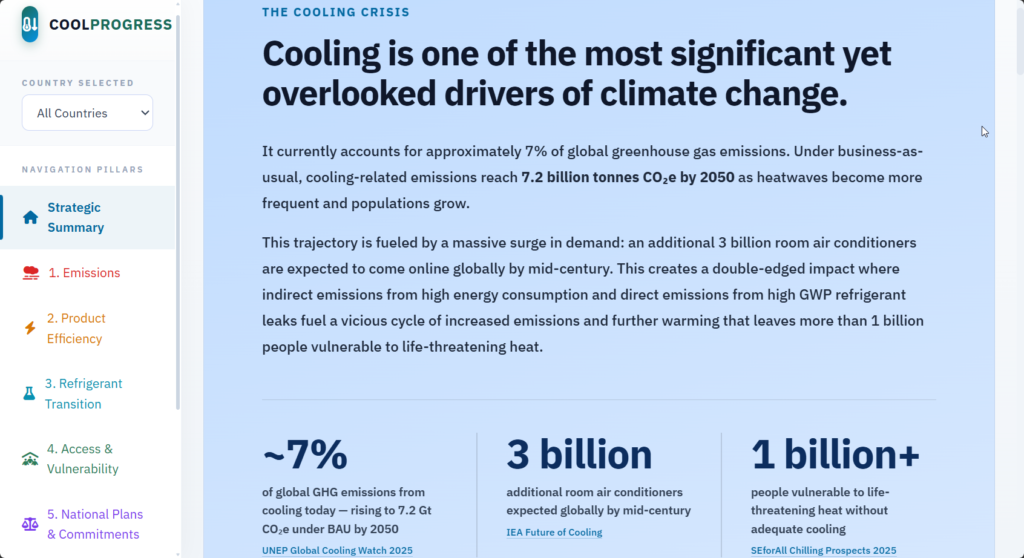
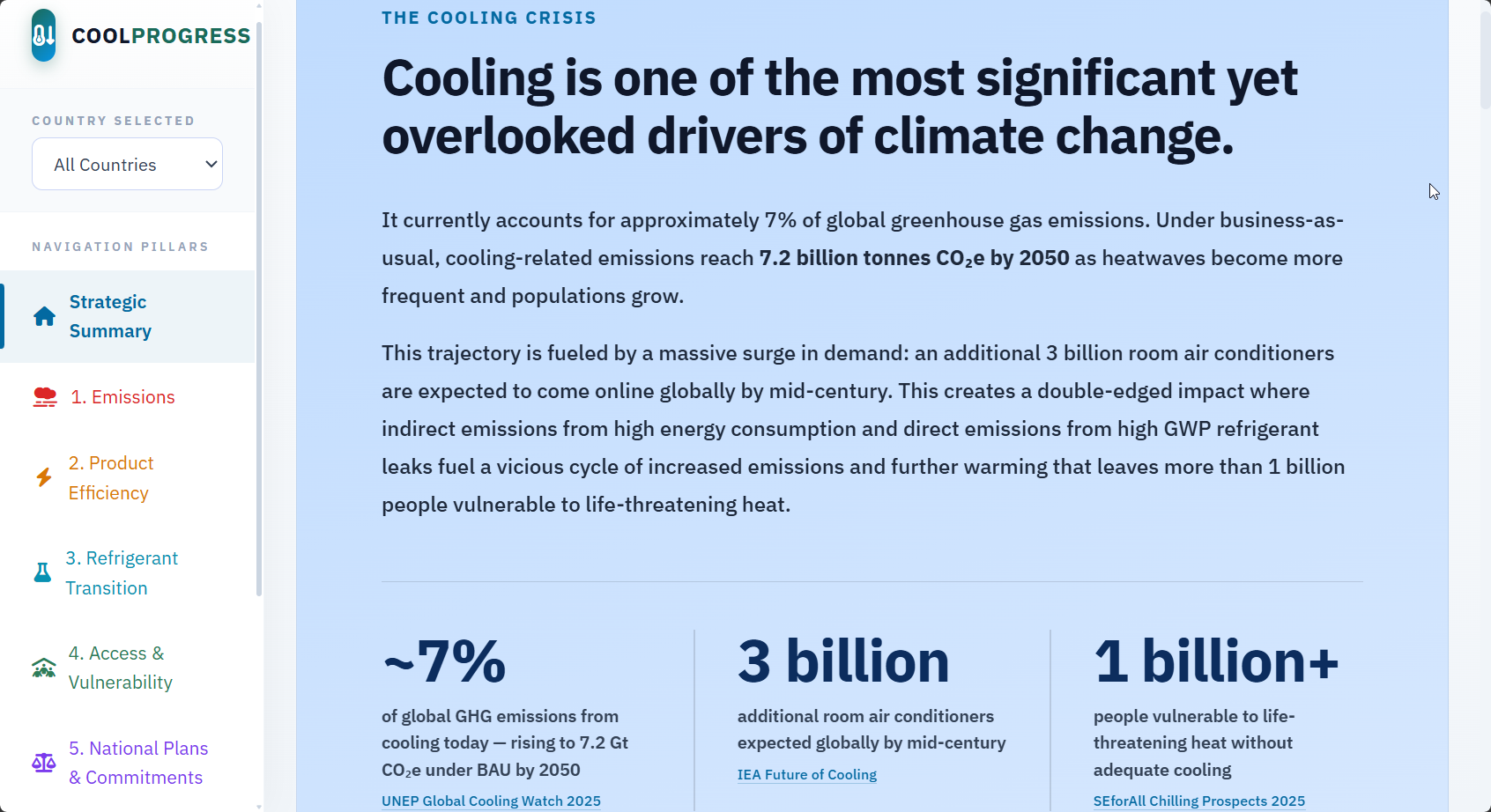
7% of global greenhouse gas (GHG) emissions come from the cooling sector today and the sector is one of the fastest growing sources of emissions. Yet the data needed to understand where these emissions come from and to drive effective action remains scattered across dozens of organisations, is inconsistently updated, and difficult to access. This fragmentation hampers policy coordination, slows investment decisions, and prevents the large scale technology deployment urgently needed to meet climate targets. Coordinated international action in the cooling sector alone could avoid up to 460 GtCO₂eq of emissions over the next four decades. This is equivalent to several years of current global emissions.
To tackle this, the CoolProgress dashboard brings together cooling sector data and partners into one integrated solution: an online dashboard for data tracking, visualization and analysis.
The CoolProgress dashboard
HEAT GmbH is leading the development of the CoolProgress dashboard on behalf of the Clean Cooling Collaborative (CCC), working in close collaboration with a high profile partner ecosystem, including Lawrence Berkeley National Laboratory (LBNL), CLASP, the International Energy Agency (IEA), UNEP Cool Coalition, Sustainable Energy for All (SEforALL), United for Efficiency (U4E), and the Climate Policy Radar. The aim is to collect and consolidate global cooling data, which is fragmented and dispersed, into a single, validated, publicly accessible database in the form of an online dashboard.
The platform, which is still under development and planned to be accessible for the partners by 2026, consolidates the following data:
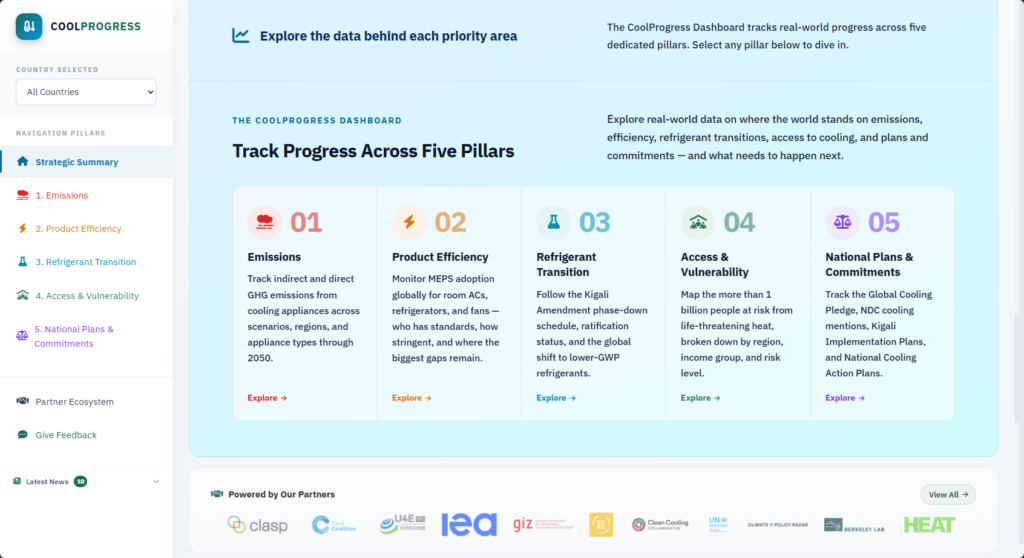
- Data across five pillars:
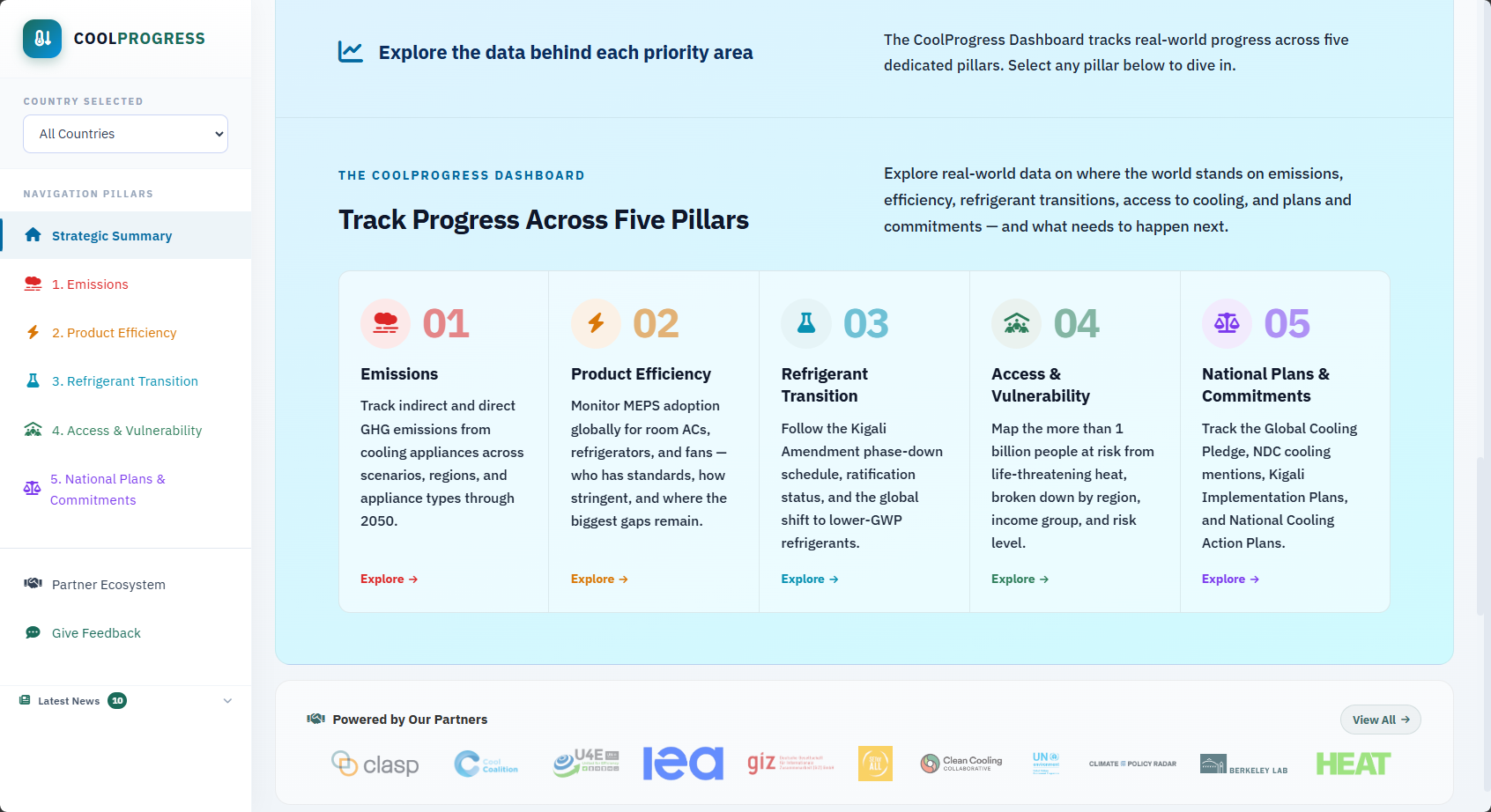
- indirect and direct GHG emissions from cooling appliances;
- product efficiency and MEPS (Minimum Energy Performance Standards) and labels;
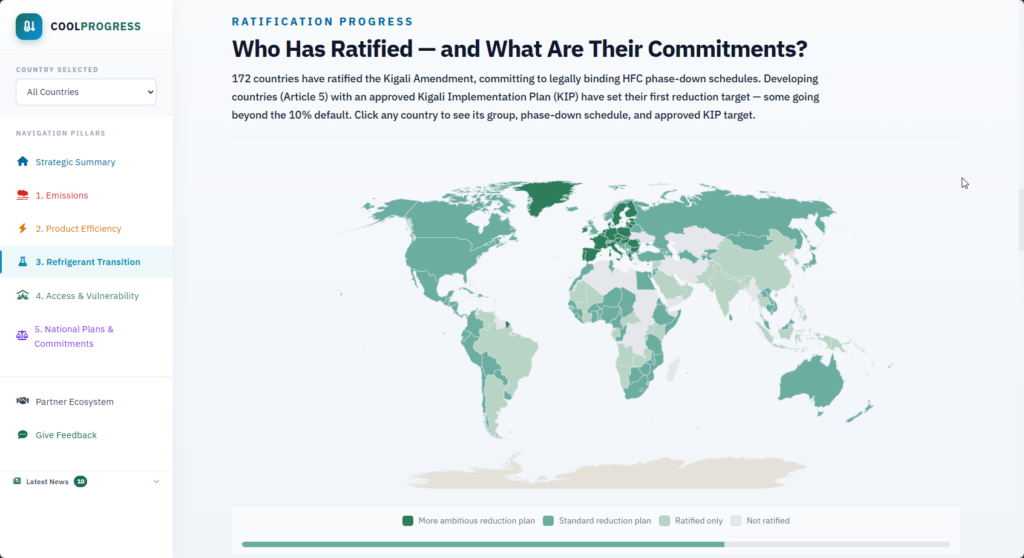
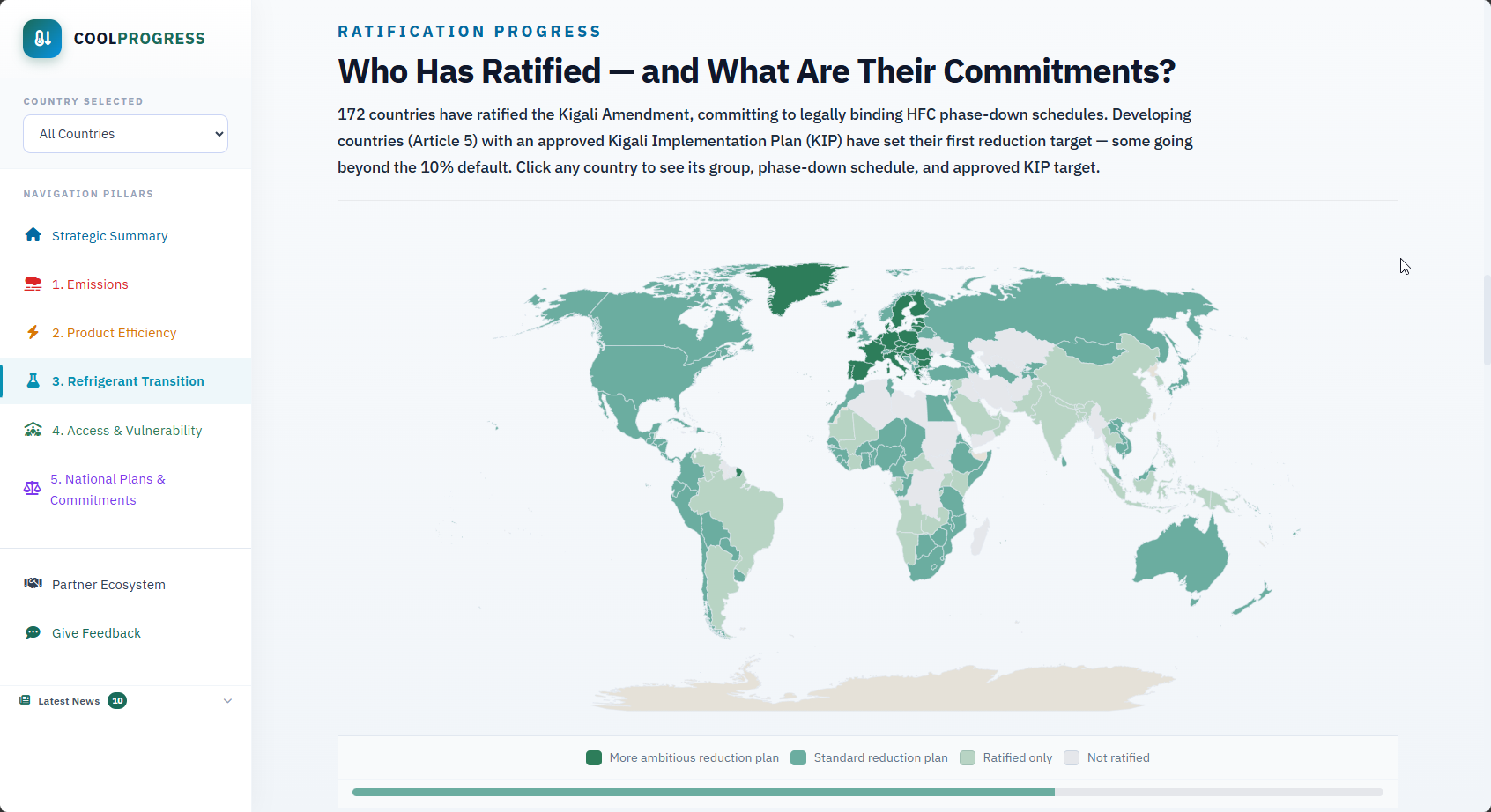
- refrigerant transition and Kigali Amendment status;
- access to cooling; and
- plans and commitments tracking the cooling governance landscape (Global Cooling Pledge implementation, NDC (Nationally Determined Contributions under the Paris Agreement) and NCAPs (National Cooling Action Plans).
- Country emissions: comprehensive cooling CO2 emission profiles that allow users to explore a full breakdown by appliance type and emission source.
- Equipment: split air conditioners, refrigerators, and fans.
Data is sourced from authoritative partners and continuously refreshed through direct API integrations.
The dashboard offers multiple user applications, such as:
- Clear and visual understanding the cooling sector, challenges and possible solutions for sustainable cooling;
- Exploring country profiles: deep dive analysis with comparative benchmarking across all five pillars (e.g. country CO2 emissions);
- Monitoring cooling access risks by country: via an interactive vulnerability map;
- Tracking policy progress: real-time updates on countries’ NDC and NCAP commitments, Kigali Amendment status, and Global Cooling Pledge implementation;
- Running scenario models: project policy impacts and technology transition pathways;
- Accessing raw data via open API integration for custom research and third-party applications, including links to data sources and partner data.
Because of the interactive design and functionalities, the platform allows to explore current data in the cooling sector and analyze the impacts of future developments and policies. The platform is intended for both practitioners and decision makers, as well as partners from the private sector and industry, researchers and analysts, and development organisations.
What is the magic behind it?
HEAT has been developing the dashboard in strong collaboration with the partners, spanning the full project lifecycle from user requirements gathering and designing the system architecture, through data integration and frontend development, to beta testing and official public launch.
CoolProgress is built on a robust, scalable technical architecture designed for continuous data integration and multi-stakeholder access. The dashboard was developed by applying AI strategically to optimize functions, specifically data validation, anomaly detection, and intelligent data management, which enables the platform to maintain accuracy and consistency as data volumes and partner integrations scale.
At the dashboard’s core sits a relational database of 30 interconnected tables hosted on AirTable with full Artificial Intelligence (AI) integration, organized into three logical layers:
- a core foundation layer covering country profiles, appliance categories, and technical specifications for split air conditioners, refrigerators, and fans;
- a policy and market data layer encompassing MEPS standards, energy labels, building codes, NDC cooling commitments, National Cooling Action Plans (NCAPs), sales and stock data, energy consumption, emissions data, and a full refrigerant database; and
- an analysis and assessment layer covering refrigerant market share, Kigali Amendment and HFC phase-down schedules, Global Cooling Pledge commitments and progress indicators, appliance usage patterns, access to cooling, population at risk, health impact indicators, climate risk and socioeconomic vulnerability indices, cooling demand assessments, infrastructure gap analysis, affordability indices, and market barriers assessments.
The backend is powered by Supabase (PostgreSQL), handling high-performance data processing, automatic REST API generation, and the orchestration of live data feeds from partner organization. The data is integrated through dedicated API connections. Built-in cross-validation logic and anomaly detection routines run across all incoming data streams to ensure consistency and quality across all 30 countries.
The frontend is developed on the SvelteKit ecosystem, with D3.js and ECharts driving interactive, customizable data visualizations tailored to different user groups. The entire infrastructure is deployed on Cloudflare Pages, modular architecture, optimized through database indexing and normalization designed to scale to additional countries, appliance categories, and data sources while maintaining 99.9% uptime and supporting real-time updates across all dashboard views and API endpoints.
The CoolProgress dashboard represents the culmination of HEAT’s 30 years of climate and cooling expertise in international development cooperation, now powered by innovative digital solutions. As one of the first projects where HEAT has developed and applied an AI process from scratch as an inherent part of its methodology, the platform sets new benchmarks in data validation. By strategically integrating these AI-driven tools, CoolProgress ensures peak precision for the international community, maintaining high-fidelity insights even as global data volumes continue to scale.
For further reading on the cooling challenges and solutions, you can read more on the Clean Cooling Collaborative, the Cool Coalition , and join the Global Cooling Pledge.
Contact
